STATEMENT | “The Munteanu Cabinet is political, yet the technocratic PM could serve as a bridge between sides”
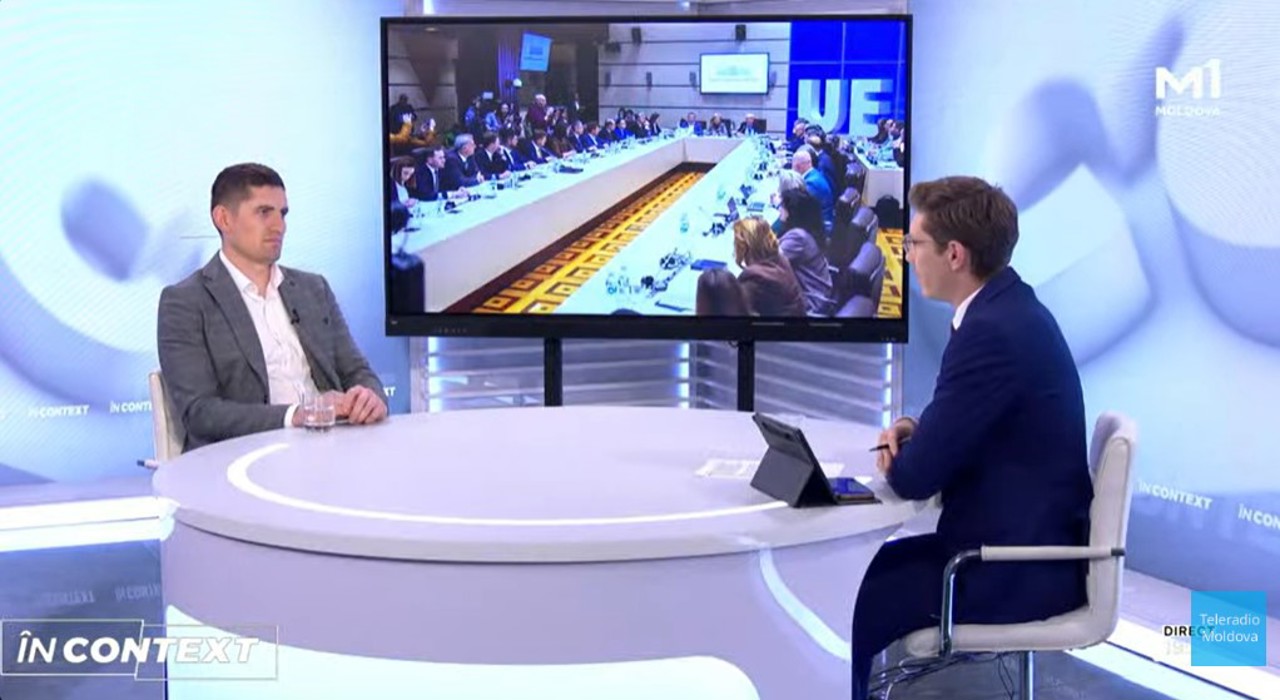
Although half of the ministers in the Munteanu Government are technocrats, it remains a political executive supported by the governing party. Stefan Bejan from WatchDog.md expressed his concerns on the show IN CONTEXT on Moldova 1 TV, stating that he doubts the new government will receive broad support in Parliament. This is despite several parliamentary factions declaring their pro-European stance.
Ștefan Bejan emphasized the lack of support from the opposition but highlighted the potential of a technocratic prime minister to serve as a mediator between the government and the opposition, which could foster constructive dialogue in Parliament.
“It is clear that no opposition party will vote for the Munteanu Government, and it is logical for this to happen. You cannot vote for a political government and then assume it. On the other hand, it is beneficial that the prime minister is still a technocrat and is outside of politics. This can give him greater legitimacy and enable him to serve as a link between the ruling party and the opposition. I hope we reach a level of political maturity where, despite ideological differences, there is constructive dialogue,” stated Ștefan Bejan on October 29 during a public television broadcast.
The expert praised the designated prime minister's consultations with parliamentary factions, noting that initial dialogue could improve the quality of legislative processes.
"We see that the designated Prime Minister has reached out to discuss matters with opposition political parties. This is a very positive step and marks the beginning of dialogue. We hope this dialogue will be constructive and that, this time, the opposition will not exclude itself from the legislative process. Instead, it should actively participate with draft laws, amendments, debates, and criticisms of the government. This involvement could enhance the quality of legislative work," the analyst remarked.
Analyzing the composition of the new government, Bejan explained that while it includes ministers who are not members of the Party of Action and Solidarity (PAS), the Cabinet remains politically affiliated with the governing party.
"Even though several ministers in the Munteanu Government are not PAS members, the Cabinet is voted in by the parliamentary majority of a political party. Therefore, it is not a purely technocratic government; rather, it is a political government, as to be expected. In the current context, we have a PAS government. What is the mayor of Chișinău, who is from a different political party, doing there? It seems to me like populism," emphasized the WatchDog expert.
During the same show moderated by Radu Osipov, Bejan described the government program released by designated Prime Minister Alexandru Munteanu as "ambitious," but lacking in "concrete implementation mechanisms." He cautioned against reliance on external funds and advocated for reforms that would ensure financial sustainability.
"There are some very concrete elements in the program, such as a minimum wage of 10,000 lei, an average wage of 25,000 lei, and the paving of 3,000 km of roads. However, the weak point of this program is that we do not have clear mechanisms for implementing these goals. I thoroughly analyzed the electoral program of the PAS government in 2021, and I found that, like that of previous efforts, many generalities were set but were not fulfilled," the analyst noted.
Bejan also highlighted the need to implement local administration reform and suggested abolishing district councils to reduce unnecessary expenses.
"By 2027, we will have over 11,000 district and local councilors who will receive a one-time allowance at the end of their councilor mandate. This allowance equals the average salary in the economy from the previous year, which means it will be over 16,000 lei. A simple calculation shows that the state will spend several hundred million lei just to pay allowances to councilors whose leadership qualities are questionable," concluded Ștefan Bejan.
We would like to point out that, before the inauguration vote on October 31, Prime Minister-designate Alexandru Munteanu held consultations with the parliamentary factions on Wednesday, October 29.
Two of the factions – “Democracy at Home” and “Our Party” – requested the postponement of the inauguration vote by one week, arguing the need to include new proposals in the government program.
At the same time, three factions announced that they would not support the Munteanu Government, and the parliamentary majority announced that the inauguration session would take place on October 31.