DIASPORA | BRD prepares a program to help local authorities reintegrate citizens returning from abroad
The Bureau for Diaspora Relations (BRD) is set to launch a mentoring program in 2026 to assist local public authorities with the reintegration of citizens returning from abroad. Violina Donu, the head of BRD, announced this initiative during the fifth edition of the Forum of the Alliance of Native Associations of Moldova, held on November 13 in Chisinau.
Violina Donu emphasized at the event that the development programs implemented by the BRD are designed not only for Moldovan citizens living abroad but also for those in the country. The Alliance of Native Associations, which carries out projects in numerous localities throughout the Republic of Moldova with the support of the diaspora and external partners, serves as "an essential umbrella" that facilitates local cooperation and promotes development initiatives. These initiatives include programs such as DAR 1+, Diaspora Impact, and the Diaspora Engagement Hub.
"These actions contribute to the development of human and social capital, the reintegration of young people into their communities, and the connection between diaspora citizens and the Republic of Moldova. The diaspora is not far away – it is here, more present than ever," stated Violina Donu.
Violeta Ciupercă, executive director of the Alliance of Native Associations of Moldova, highlighted that the 100 native associations work closely with local public administrations on a daily basis.
"These organisations build bridges between those living at home and those in the diaspora, fostering community development and mutual inspiration," Ciupercă emphasised.
Switzerland, a constant partner of communities in the Republic of Moldova
The Swiss government has supported the Republic of Moldova for over a decade, acting not only as a development partner but also "as a friend who believes in the potential of individuals at home and in the diaspora."
Guido Beltrani, director of the Swiss Cooperation Office in the Republic of Moldova, commended the Alliance of Native Associations at the forum, noting that it "serves as a platform close to people and communities, understanding the realities of villages and cities while maintaining contact with fellow citizens in the diaspora."
He reported that the Alliance directly helps improve the lives of over 351,000 people and mentioned the expansion of the Next Level grant program, supported by Switzerland, to 30 communities in the country.
"Today, through its efforts, the Alliance is enhancing the lives of over 351,000 people. The Next Level training and grant program, backed by Switzerland, is currently being launched for 30 communities in the country. Additionally, six indigenous associations have been established in the Security Zone, with the Alliance providing careful guidance throughout this process. I am pleased to see that interventions initiated with the support of the Swiss Government have continuity, now being reinforced by the Alliance alongside other development partners, such as the German Foreign Ministry, GIZ, and the International Organization for Migration. These initiatives – including children's camps, communication campaigns, the Junior Club, and the School of the Alliance of Indigenous Associations of Moldova – create a strong collaborative infrastructure that yields concrete results in the communities. I am especially impressed by how active the Alliance is at the national level, representing the interests of civil society organizations in the country," emphasized Guido Beltrani.
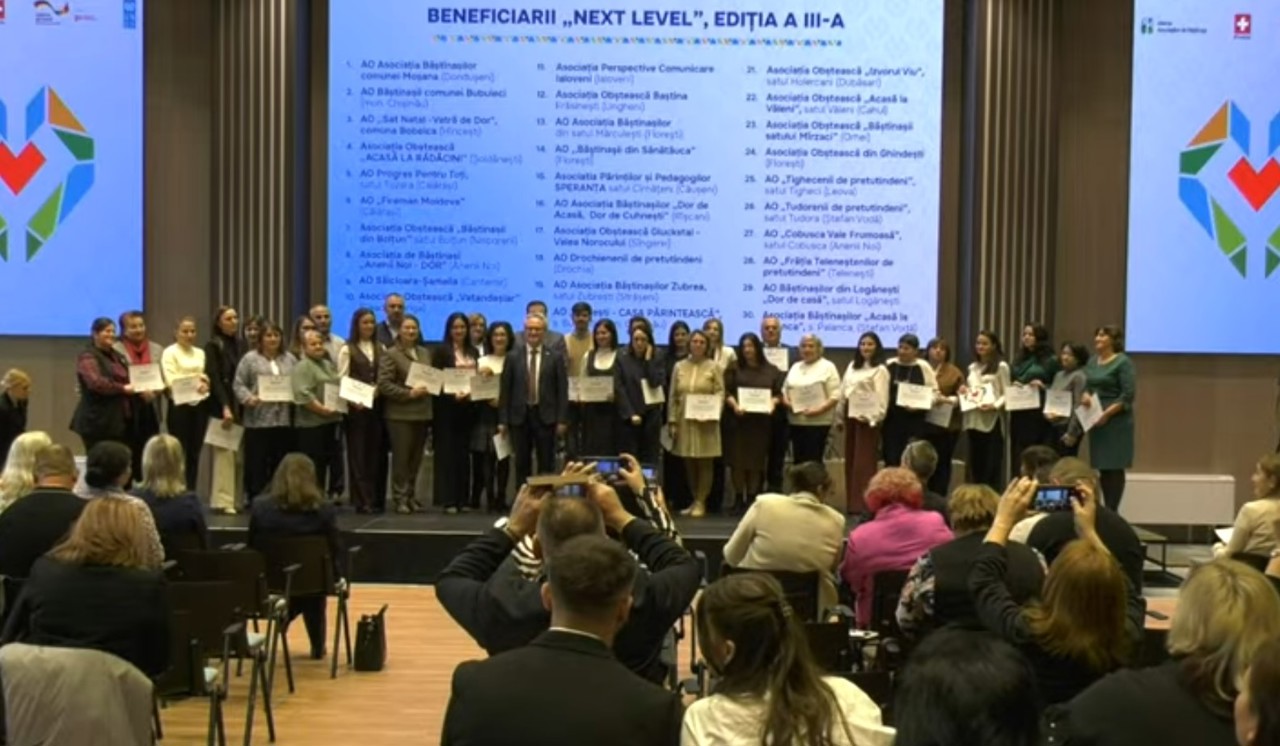
During the forum, 30 native associations and local public authorities contributing to community development were recognized, with 30 local leaders and members of the Alliance selected to receive support through the Next Level program, now in its third edition and implemented with assistance from the Swiss project Strengthening Social Cohesion.
Furthermore, Claudia Hermes, country director of GIZ Moldova, presented certificates to 10 associations that will organize the summer camps "AcasaCamp 2025," aimed at reconnecting children from the diaspora with their places of origin.
To date, the native associations, composed of locals and citizens from the diaspora, have successfully mobilized to engage in the development of their communities, improving local public services in over 120 localities across the Republic of Moldova.
The projects implemented in the villages and cities of the Republic of Moldova mainly focus on enhancing public areas, constructing stadiums, purchasing containers for improved waste management, establishing daycare centers for the elderly, developing alternative therapies and educational services for children with special needs, and enhancing conditions in educational institutions, among other initiatives.