Parliament votes in first reading to denounce the Cultural Centers Agreement with Russia.
The Republic of Moldova has decided to withdraw from the agreement with the Russian Federation regarding the establishment and operation of cultural centers. This project, initiated by the Ministry of Culture at the request of the Ministry of Foreign Affairs, was adopted by Parliament in its first reading, with 60 deputies supporting it. Besides the PAS faction, the initiative also garnered backing from the Democracy at Home faction.
Action against politicization, disinformation, and terror
During a meeting on November 13, Minister of Culture Cristian Jardan presented a project aimed at addressing the challenges posed by politicization, disinformation, and terrorism. He emphasized that the denunciation of the agreement does not constitute an action against Russian culture or language, both of which continue to be respected in the Republic of Moldova. Instead, it targets the use of culture as a disguise for geopolitical interests, the justification of aggression, and the spread of disinformation and terror, which contradict the essence of culture, art, and beauty.
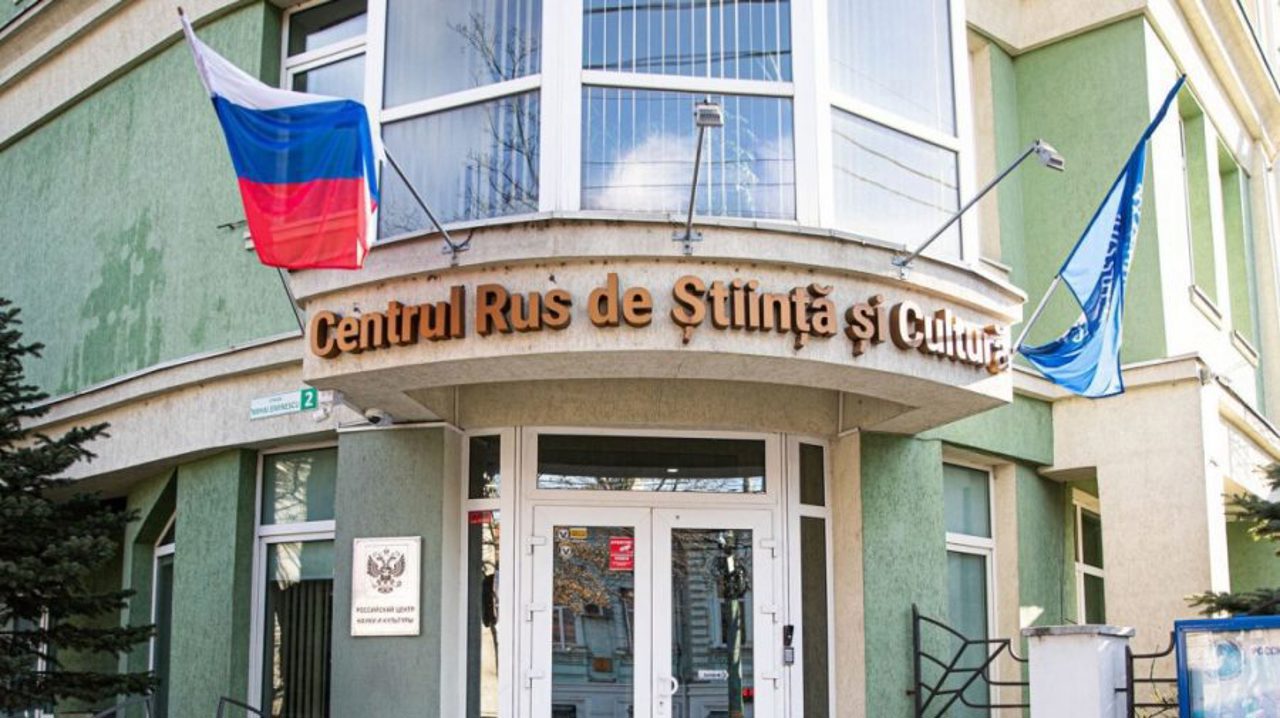
The Minister explained that this agreement, established in 2009, led to the creation of the Russian Center for Culture and Science (Ruskii Dom), which is financed and managed by Rossotrudnichestvo—the federal agency responsible for relations with the Commonwealth of Independent States. This agency is currently under international sanctions.
Rossotrudnichestvo is led by Yevgeny Primakov, son of a former Russian prime minister. The Minister pointed out that shortly after the Moldovan Ministry of Foreign Affairs announced the termination of the agreement in March 2025, Igor Cheaika was appointed as the agency's vice president by a decree from Russian President Vladimir Putin. Jardan humorously referred to Cheaika as a “well-known cultural personality”.
According to Jardan, Cheaika has various interests in Moldova, particularly on the left bank of the Nistru, in areas related to cryptocurrency and electricity. He is on the European Union's sanctions list for actions aimed at destabilizing Moldova and was a member of the Coordination Council of the “Delovaya Rossia” Association from 2017 to 2025.
A risk to national information security and regional stability
Jardan further noted that following Russia’s military aggression against Ukraine on February 24, 2022, the agreement could be exploited to promote Russian propaganda in Moldova, posing a risk to the country’s information security and that of the entire region.
He recalled that in November 2022, Chisinau, Balti, Comrat, and Tiraspol—hosted screenings of films intended to justify Russia's aggression against Ukraine by distorting facts and masking the Russian Federation's true intentions.
“Considering that the Republic of Moldova has never gained and does not benefit from a similar cultural center in the Russian Federation, there is no equitable mechanism for promoting our culture or disseminating information about our country. This undermines the agreement's balance and original purpose. By denouncing it, all its legal implications cease definitively,” the Minister concluded.
Support for Russian-language schools with European funding
Deputy Speaker of Parliament, PAS MP Doina Gherman, confirmed the minister's statements, emphasizing that the denunciation of the agreement is not an action against Russian culture or language, nor against Moldovan citizens of Russian ethnicity, as some opposition MPs have suggested.
Gherman mentioned that there are 260 schools in the Republic of Moldova that teach in Russian. She highlighted the “Dmitrie Cantemir” Lyceum in Balti, which received 39.8 million euros in European funding between 2020 and 2023.
"This is about the children, teachers, professors, and employees of this institution. It signifies respect. It includes thermal insulation of the building, installation of drainage systems, electrical protection, installation of photovoltaic panels, modernization of the kitchen, sanitary facilities, and ventilation systems—ensuring that all conditions meet high European standards for this lyceum. This is a concrete example of respect and appreciation," said the parliamentarian.
Government accused of inciting conflict
In response, Deputy Speaker of Parliament, PSRM deputy Vlad Batrîncea, asserted that it is the state's responsibility to support educational institutions. However, he accused the government of not seeking intelligent solutions and instead "putting citizens on the barricades."
"You are not seeking consensus or balance; you are escalating conflicts and polarizing society. We consider this a useless project with no significance for the Ministry of Culture. It is yet another initiative that creates new problems in society," stated Batrîncea.
He also accused the Minister of Culture of "not caring about culture," pointing out that the first project presented in the plenary session of Parliament was political in nature. In this context, he directed a question towards the Minister.
"Show me the information about the money I donated for the Philharmonic. When the building burned down, my colleagues and I also donated. I want my money back, as we consider it stolen. Care about culture, not politics!" said the deputy.
PCRM: Denouncing the Agreement will hurt Moldovan citizens
PCRM parliamentarian Inga Sibova argued that while severing economic relations with the Russian Federation had an immediate negative impact, the effects of cutting cultural ties will be felt over time, leading to the "impoverishment of our cultural code."*
"Regardless of how much the parliamentary majority wants to upset the Russian Federation, the closure of the Russian Cultural Center will not affect the Russian people, but rather the Moldovan people. It is now clear that the Munteanu Government is not focused on development, modernization, and improvement, but on destruction, prohibition, and liquidation," concluded the parliamentarian.
The agreement on the establishment and operation of cultural centers, signed by the governments of the Russian Federation and the Republic of Moldova on October 30, 1999, entered into force on July 4, 2001. This document does not provide for early termination and is automatically renewed every five years unless either party notifies the other of its intention not to renew it at least six months before its expiration. The Republic of Moldova intends to take action immediately after the vote in Parliament.