Census 2024: Only 44% economically active, over 1 million outside the labor market
The Republic of Moldova has one of the lowest labor force participation rates in recent years, based on the final data from the 2024 Population and Housing Census, presented on November 25 by the National Bureau of Statistics (NBS). Only 44% of individuals aged 15 and older are economically active, which means that over a million people are currently outside the labor market.
Also, the unemployment rate has risen to 9.3%, with young people and residents of rural areas being the most affected, creating a challenging socio-economic situation.
According to data from the National Bureau of Statistics (NBS), out of the total population aged 15 and older—1.946 million individuals—only 44.3% are part of the labor force, while 55.7% are inactive.
Most rural residents do not have jobs.
The final data from the 2024 Census reveals that just 44.3% of Moldovans aged 15 and over are actively participating in the labor market, either being employed or seeking employment.
The labor force consists of 862.9 thousand people, while approximately 1.08 million individuals, or 55.7%, are outside the labor market.
Among the population aged 15-64, participation is higher: 54.3% are economically active, while 45.7% are inactive.
There are significant differences between urban and rural areas. In urban regions, the active population exceeds the inactive population, with 52% active and 48% inactive. In contrast, in rural areas, 62.3% of residents are unemployed.
Additionally, men are more active than women: 49.8% of men aged 15 and over are part of the labor force, while the participation rate among women is significantly lower at 39.7%.
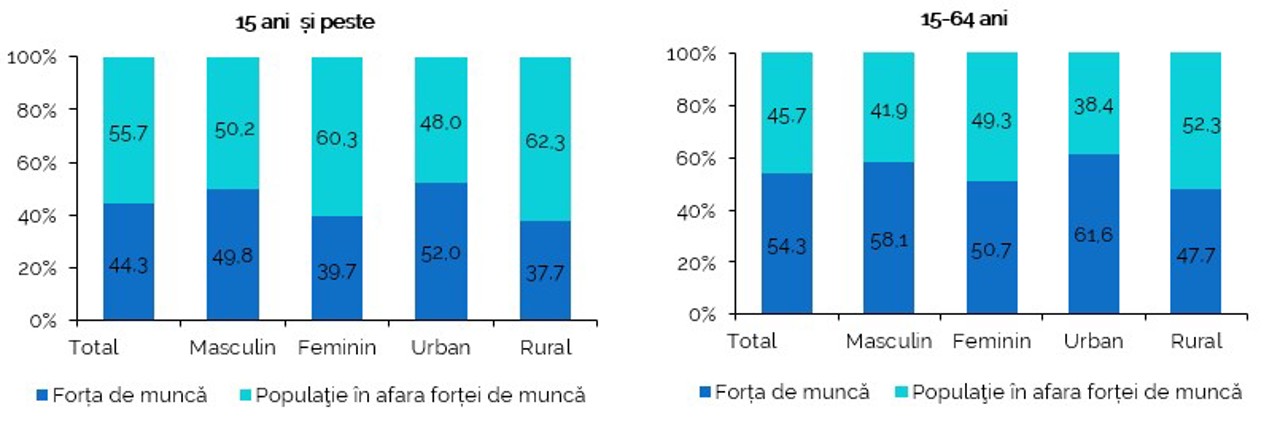
For the 15-64 age group, which is considered the working age, the labor force participation rate is 58.1% for men and 50.7% for women.
The area of residence also affects access to the labor market. In urban areas, the participation rate is 61.6%, nearly 14 percentage points higher than in rural areas, where it is 47.7%.
Overall, there are 820.6 thousand economically active individuals in the 15-64 age group. Of these, 741 thousand are employed, accounting for 90.3%, while 79.6 thousand are unemployed, making up 9.7%.
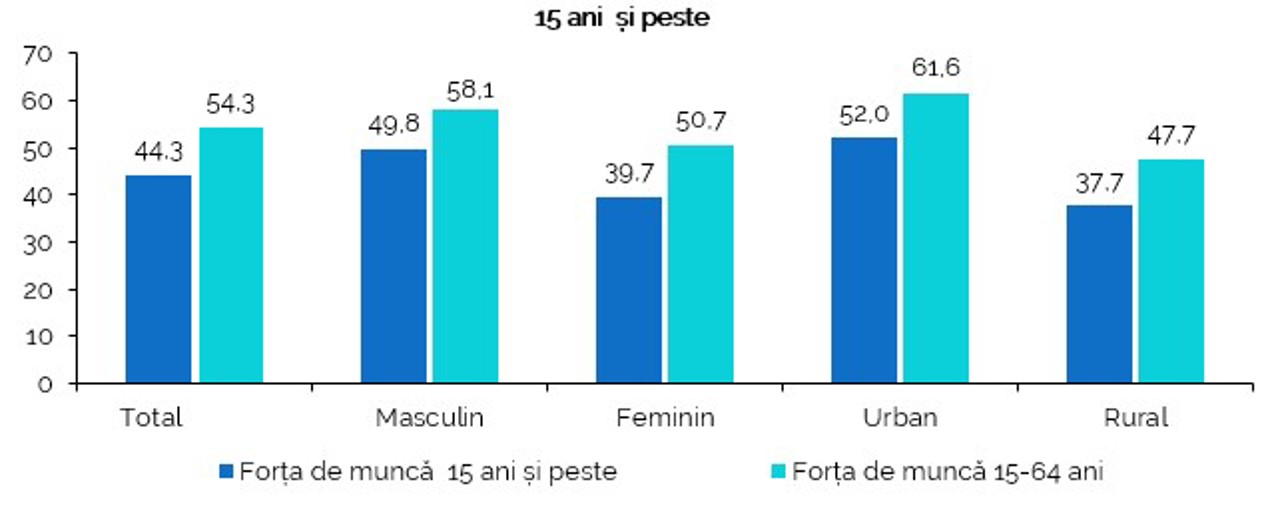
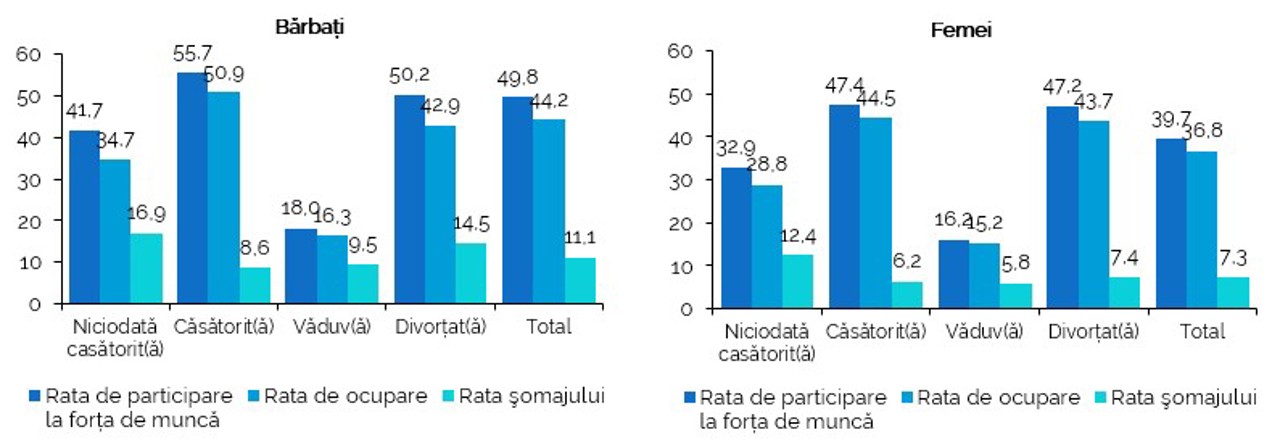
The labor force participation rate is highest among married individuals, reaching 51.4%. In urban areas, this rate increases to 60.6%.
There are noticeable gender differences in participation rates. Married men have a labor market participation rate of 55.7%, while married women stand at 47.4%.
Divorced individuals follow, with participation rates of 50.2% for men and 47.2% for women.
The lowest labor market participation rates are found among people who have never been married, where 41.7% of men and only 32.9% of women are economically active.
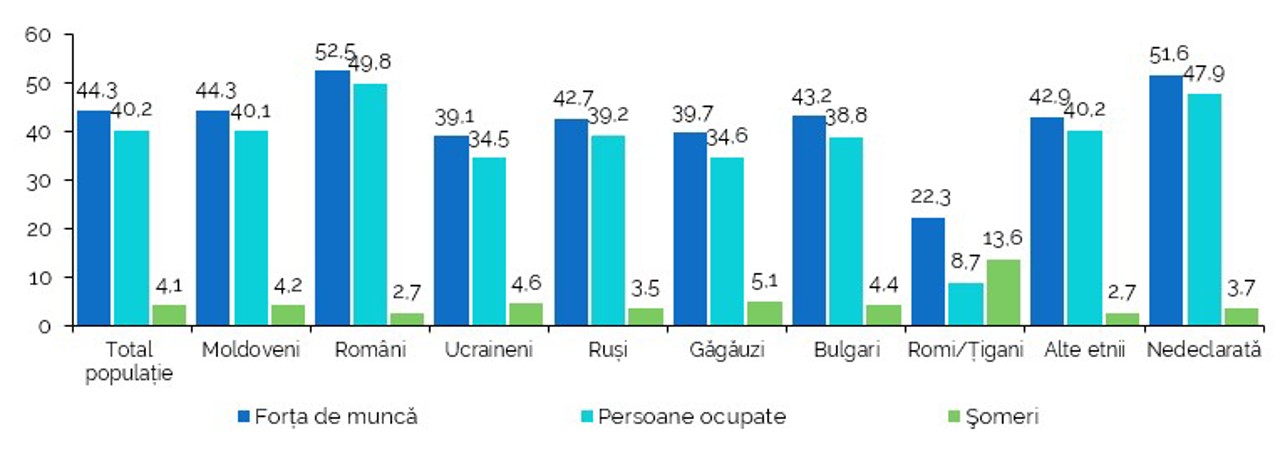
Significant differences in labor market participation among ethnic groups: Romanians are the most active
Labor market participation varies significantly among ethnic groups in the Republic of Moldova. Romanians report the highest economic activity, with a participation rate of 52.5%. In comparison, Moldovans have a participation rate of 44.3%, while Bulgarians have a participation rate of 43.2%. Russians have a similar participation rate of 42.7%.
In contrast, the Roma community has the lowest participation rate, with only 22.3% of adults being economically active.
Additionally, the Roma face the highest unemployment rate, with 13.6% of individuals actively seeking jobs. They are followed by the Gagauz, who have an unemployment rate of 5.1%, and Ukrainians, with a rate of 4.6%.
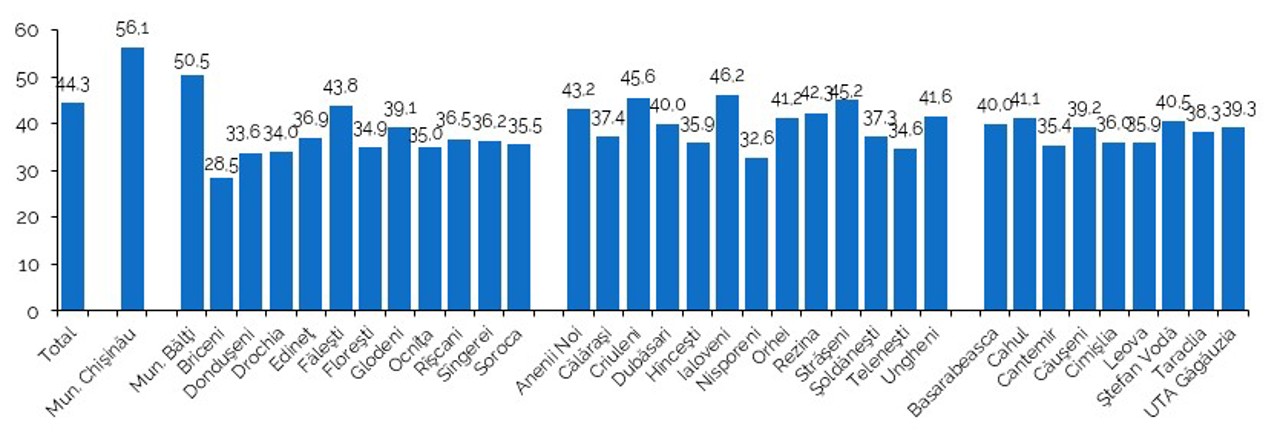
The labor force participation rate in the Republic of Moldova varies significantly across different districts and municipalities, ranging from a low of 28.5% to a high of 56.1%.
The highest participation rate was recorded in the municipality of Chișinău at 56.1%, followed by Bălți at 50.5%. Ialoveni (46.2%), Criuleni (45.6%), and Strășeni (45.2%) also show rates above the national average of 44.3%.
Conversely, 31 districts have participation rates below the national average. The lowest levels of economic activity were found in Briceni (28.5%), Nisporeni (32.6%), and Dondușeni (33.6%). Authorities in these areas have noted a high degree of population aging, which may contribute to the lower participation rates.
Employed population
According to the 2024 Census data, there are 782.6 thousand individuals aged 15 and older employed in the Republic of Moldova. The overall employment rate is 40.2%, indicating that less than half of adults are in the workforce.
There are notable differences between men and women, with 44.2% of men over 15 employed, compared to 36.8% of women.
Additionally, significant disparities exist between urban and rural areas. In urban areas, the employment rate is 48.9%, which is 1.5 times higher than in rural villages, where it stands at only 32.7%.
The 2024 Population and Housing Census data reveals that individuals aged 40 to 44 have the highest employment rate at 61.7%, followed closely by the 35-39 age group at 60.6% and the 45-49 age group at 60.2%. In contrast, the lowest employment rates are observed among those aged 70 and older (5.1%) and among young people aged 15-19 (6.8%).
For men, the highest employment rate is found in the 30-34 age group at 63.5%, while for women, it is in the 45-49 age group at 62.5%.
Employment by education level
About half of the employed population, 49.7%, has completed secondary education, while 34% hold higher education qualifications and 16.4% have a lower level of education.
Among individuals with higher education, women represent a higher percentage than men, with 39.3% compared to 28.9%.
According to the data, the Chisinau municipality accounts for 39.4% of the total employed population. The employment distribution in other regions is as follows: the Centru region has 25%, the Nord region has 21.1%, the Sud region has 10.9%, and the Gagauzia Autonomous Region has 3.6%.
Areas of employment
The services sector dominates the labor market, comprising 67.9% of employed individuals. Industry accounts for 14.6%, construction for 9.9%, and agriculture for 7.6%.
In agriculture, men are more represented than women, with 10.7% of men employed compared to just 4.4% of women. Additionally, rural residents are significantly more involved in agriculture, working 6.6 times as much as urban residents (14.6% compared to 2.2%).
In construction, men represent 18.2% of all employees, while women account for only 1.3%. Conversely, women dominate the service sector, making up 81.1% of employees, and urban residents constitute 76.3% of the workforce in this sector.
Most common occupations
Specialists in various fields form the largest professional category, representing 22.1% of the workforce. They are followed by skilled workers at 15.2% and workers in services and trade at 14.5%. The smallest percentage of employees is skilled workers in agriculture and fisheries, at only 2.2%.
Women are 2.2 times more prevalent among specialists than men, with 30.8% of specialists being women compared to 13.8% men. On the other hand, men are 3.6 times more represented in the skilled workers category, with 23.6% of skilled workers being men compared to 6.6% women.
In urban areas, specialists dominate the workforce, comprising 27.6% of employees, while in rural areas, unskilled workers are more common, making up 19.5% of the workforce.
In 2024, 95.1% of employed individuals are salaried workers. Self-employed individuals account for 3.5%, employers for 1.1%, and unpaid family workers for 0.2%.
Among the total employed population of 782.6 thousand people, 69.8% work in their locality of residence. Additionally, 13.2% work in nearby localities within the same district, 10.5% work in different districts or municipalities, and 5.8% are employed in another country.
Young people aged 15 to 24 are the most mobile; 16.9% work in another district, while 8.6% work in another country. In contrast, individuals over the age of 65 tend to remain in their local area, with 82.1% doing so.
In urban areas, 88.7% of employees work in the same locality, compared to only 45.6% in rural areas, where nearly one-fifth (19.6%) work in another district.
Unemployment: Young people are the most affected
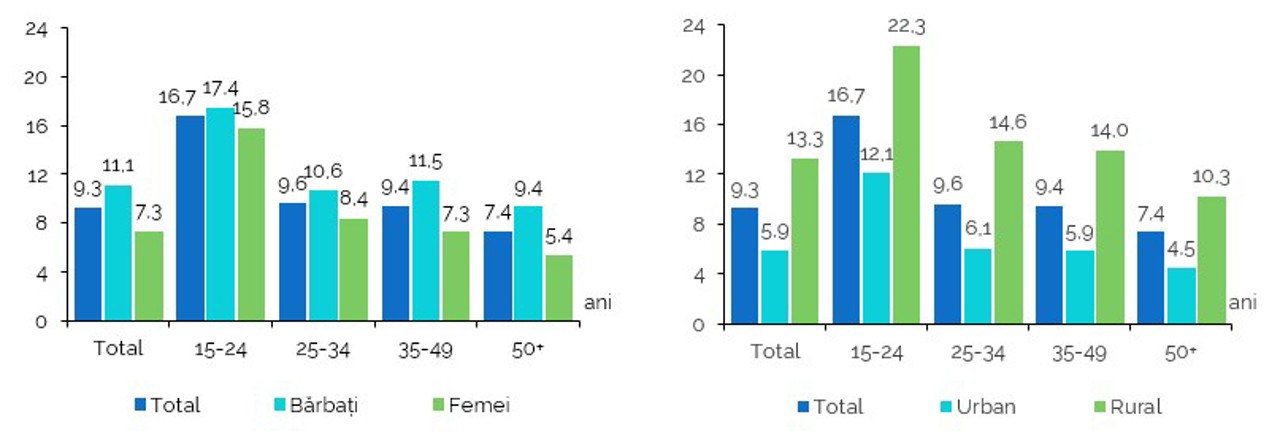
There are 80,200 unemployed individuals, resulting in an overall unemployment rate of 9.3%. The unemployment rate is higher for men at 11.1% than for women at 7.3%. Additionally, unemployment is significantly higher in rural areas, at 13.3%, than in urban areas, at 5.9%.
Young people aged 15 to 24 face the highest unemployment rate at 16.7%. In rural areas, this rate rises to 22.3%.
Among the unemployed, over half (53.1%) have completed secondary education, 12% hold higher education degrees, and 34.9% possess a low level of education.
Over a million people are out of the labor force
A total of 1.083 million people aged 15 and over, representing 55.7% of the population, are currently inactive. Women make up the majority of this group, with an inactivity rate of 60.3% compared to 50.2% for men. Additionally, the rural population has a higher inactivity rate at 62.3%.
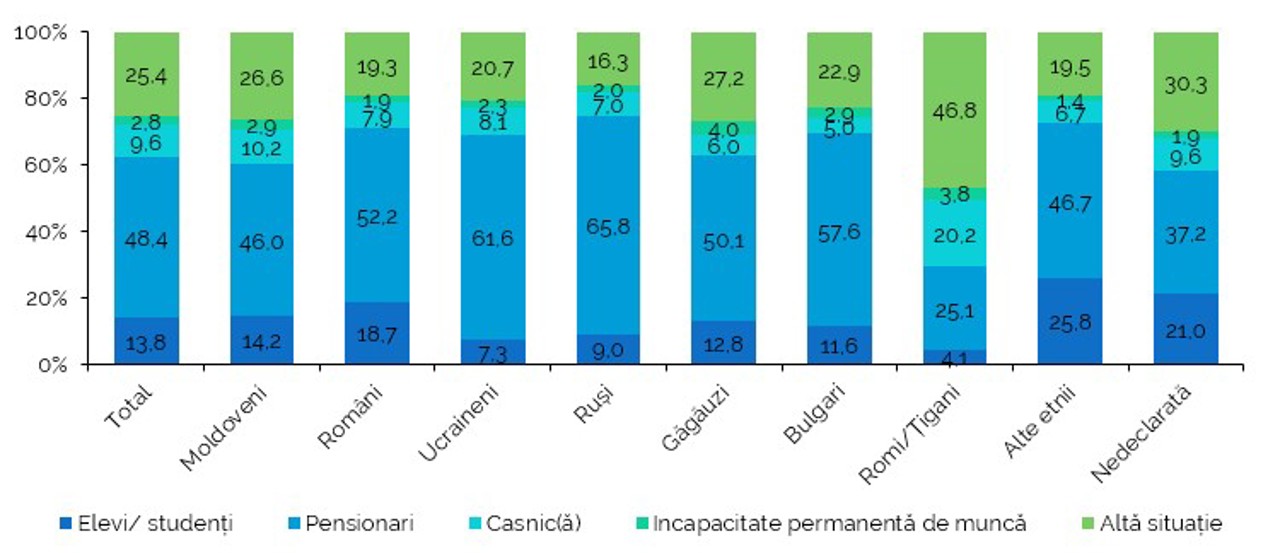
The breakdown of inactive individuals is as follows: 48.4% are pensioners, 13.8% are pupils or students, 9.6% are housewives, 2.8% have a permanent disability, and 25.4% fall into an "other situation" category, which also includes those who could potentially join the labor force.
The highest rates of inactivity are found in the districts of Briceni (71.5%), Nisporeni (67.4%), and Dondușeni (66.4%). In contrast, the lowest rates are in Chișinău (43.9%), Bălți (49.5%), and the districts of Ialoveni and Criuleni, both of which are approximately 54%.
The Roma population has the highest inactivity rate at 77.7%, followed by Ukrainians at 60.9%, Gagauz at 60.3%, and Russians at 57.3%.
Among pensioners, Russians have the highest representation at 65.8%, followed by Ukrainians at 61.6%. The category of housewives is most prevalent among the Roma/Gypsy population, accounting for 20.2%.
The Population and Housing Census is a national statistical survey conducted at least once every ten years. The most recent census took place from April 8 to July 7, 2024.
Data collection was primarily conducted through direct interviews with enumerators, who recorded responses on tablets—this was the first time this technology was used in the Republic of Moldova.
Preliminary results were released in June 2024, indicating a population of 2.4 million people and 1.6 million households.
The final results were presented by the National Bureau of Statistics (NBS) in 2025.