Romania National Day: Great Union's 107th anniversary and NATO
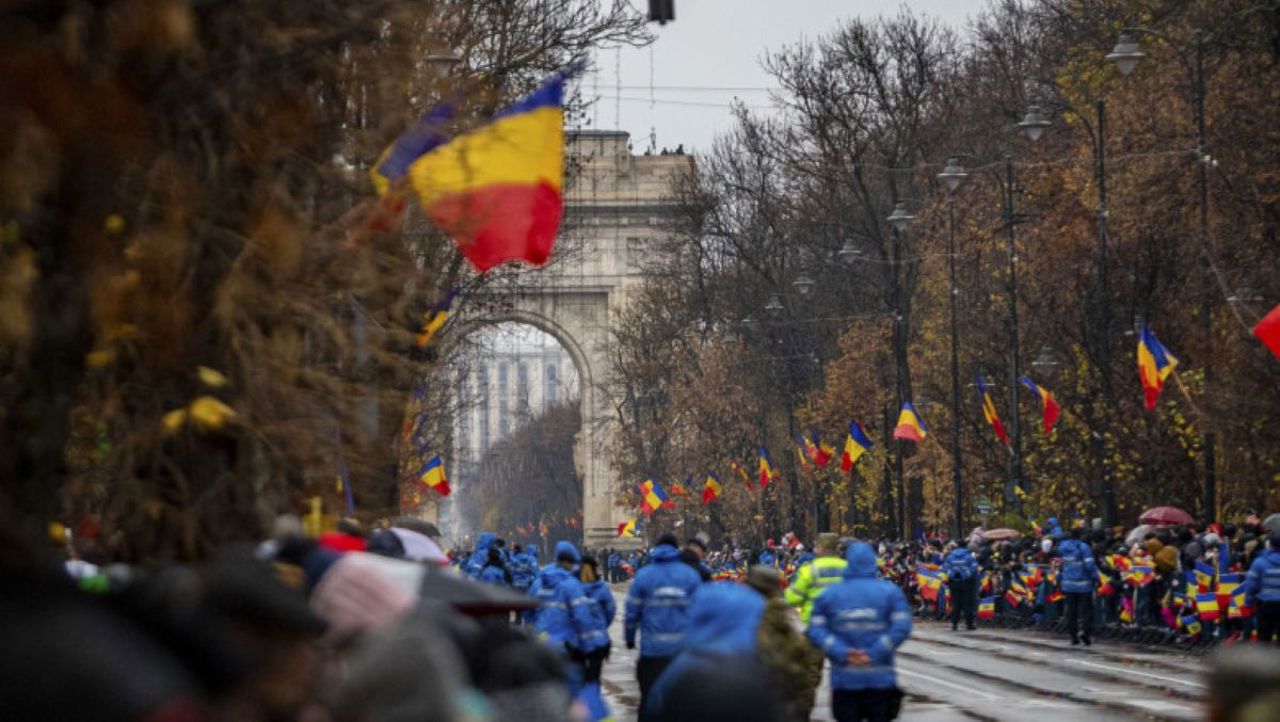
Romania is celebrating today, December 1, 2025, 107 years since the Great Union, the historic moment in 1918 when Transylvania, Banat, Crișana, and Maramureș united with the Kingdom of Romania, creating the foundation of the modern Romanian national state.
This event, now known as Romania National Day, is marked this year under the theme "Centenary Romania and the Future" and focuses on the Union's historical legacy, alongside the 20th NATO anniversary since Romania's accession.
In Bucharest, the main events include the military parade at the Arch of Triumph, where thousands of Romanian and allied troops are participating in the march and spectacular aerial demonstrations. A contingent of the National Army of the Republic of Moldova is also taking part in the event, parading alongside soldiers from NATO states.
Wreath-laying ceremonies in memory of the heroes are also scheduled, as well as a traditional torchlight parade in Bucharest.
In Alba Iulia, the symbolic city of the Union, the day features military ceremonies, grand parades, folk shows, and cultural events, which are expected to attract tens of thousands of visitors.
National Day events are also taking place across other major cities: Cluj-Napoca, Iași, Arad, Constanța, and Satu Mare, with military ceremonies, concerts, and public exhibitions.
Romanians in the diaspora will be marking the holiday through cultural and artistic events organized by the Romanian Cultural Institute in over 20 countries, including Paris, Brussels, London, Rome, Istanbul, and Beijing.
Why Romanians celebrate on December 1
On December 1, 1918, the National Assembly of Romanians was convened in Alba Iulia. The proceedings concluded with the Resolution on the unconditional union of Transylvania with Romania, which was voted on unanimously.
This pivotal act followed the earlier votes for union by the representative bodies of Bessarabia (March 27, 1918) and Bukovina (November 28, 1918).
The December 1, 1918, decision confirmed the unanimous union of Transylvania, Crișana, and Maramureș with Romania. It also stipulated the preservation of local autonomy, based on democratic principles, guaranteeing equality between nationalities and religions.
"The National Assembly of the Romanian people in Transylvania, Banat, and the Hungarian parts received the resolution presented by Vasile Goldiș in its entirety, and thus the union of this Romanian province with the mother country is decided for all time," announced Gheorghe Pop de Băsești, the president of the National Assembly.
In Alba Iulia, similar to the assembly held in Chernivtsi on November 28, the event brought together all Romanians from the Austro-Hungarian Empire.
Also in Alba Iulia, the Great Romanian National Council was constituted, composed of 200 elected members and 50 co-opted ones. The following day, the Council appointed a provisional government, named the Directing Council of Transylvania, which was led by Iuliu Maniu.
On December 11, the Great Union was ratified by the Government of Romania, and the Alba Iulia declaration was formally handed over to King Ferdinand. The King promulgated the decree sanctioning the union (including Bessarabia and Bukovina) on the same day.
A year later, on December 29, 1919, the Romanian Parliament voted the laws ratifying the union of Transylvania, Crișana, Maramureș, Banat, Bukovina, and Bessarabia with Romania.
International recognition of Bukovina's union with Romania took place on September 10, 1919, through the signing of the Treaty of Saint Germain between the Allied Powers and Austria. The union of Transylvania, Banat, Crișana, and Maramureș with Romania was recognized through the Treaty of Trianon, concluded on June 4, 1920, by the Allied and Associated Powers and Hungary.
On October 28, 1920, the Treaty of Paris was signed by Romania and the Allied Powers (France, Great Britain, Italy, and Japan) to formally recognize the union of Romania with Bessarabia. However, this treaty did not enter into force because Japan did not ratify it. Furthermore, the Soviet Union did not recognize this union, and Japan's action was linked to a secret protocol that was part of a 1925 treaty between Japan and the Soviet Union.
Translation by Iurie Tataru