Free Romanian courses: What's new in the 2026–2028 program
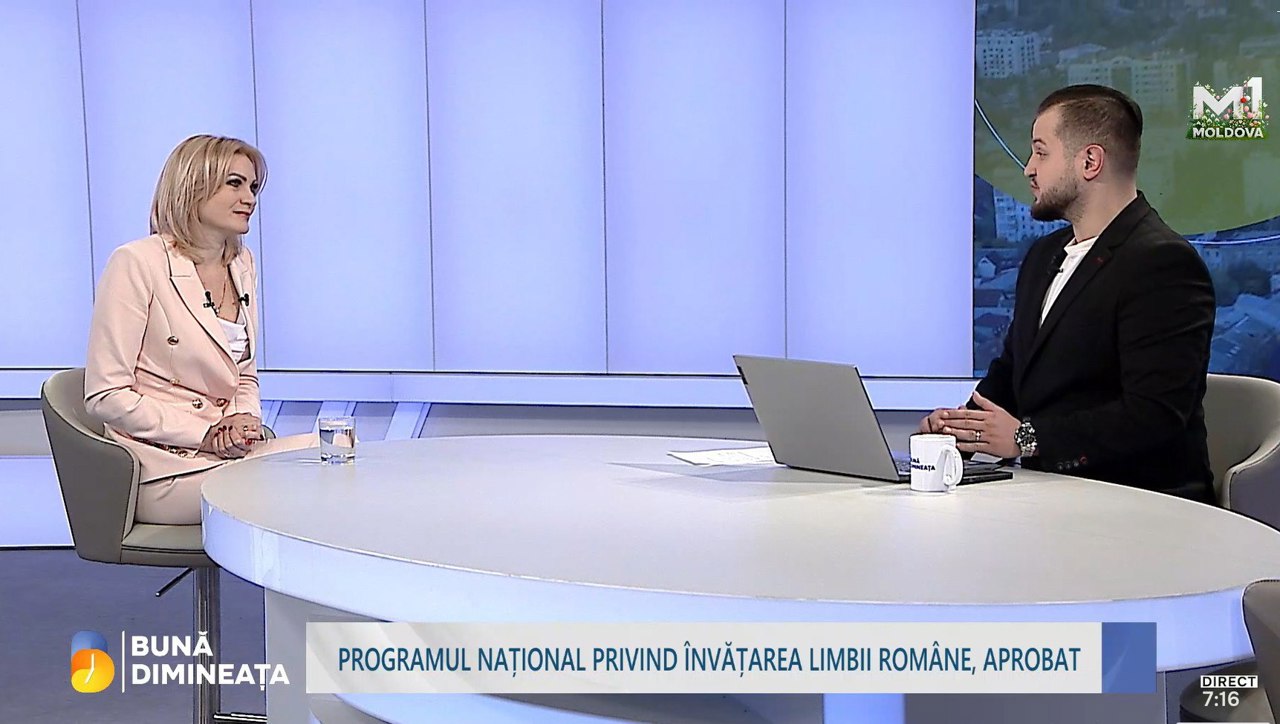
More than 25,000 people have enrolled in Romanian language courses as part of the National Program for 2023–2025, which has been extended until 2028. Marcelina Baleca, the head of the Department of Education at the Ministry of Education and Research (MEC), stated during the "Bună Dimineața" show on Moldova 1 TV that the goal is to enhance language skills and provide the opportunity for as many applicants as possible to study Romanian.
The national program for learning the Romanian language for the years 2026–2028, approved by the Government on March 4, has a budget of over 240 million lei. The program aims to strengthen communication skills in Romanian for various target groups, including Moldovan citizens, representatives of ethnic minorities, migrants, and refugees.
According to Marcelina Baleca, the head of the General Education Directorate within the Ministry of Education and Culture (MEC), the goal is to enhance communication skills in Romanian, especially for those at the initial stage of learning, and to support social integration and workforce participation for all citizens. In the previous edition of the program, 25,000 applicants participated in Romanian language classes, including teachers from minority schools. Additionally, several language camps were organized in the Republic of Moldova and Romania, benefiting approximately 1,200 children and 700 teachers.
Baleca emphasized the importance of providing ample opportunities for children and citizens to study Romanian. The new program will broaden the target groups and enhance learning opportunities. In addition to traditional courses, a digital platform will be developed to integrate more digital resources, and online groups will be created—especially for Moldovans living abroad, including those born there who do not know or speak Romanian.
The MEC official noted, "We are digitizing these courses and creating a digital platform with more interactive tools, such as videos and tutorials. This way, students will have the opportunity to access these materials both during and after the courses. We also aim to develop Romanian-language communication skills in schools. We propose creating support groups in educational institutions for children returning from abroad and for refugee children to help them assimilate the Romanian language more easily."
The program will also include vocational, technical, and higher education institutions, where a mandatory course in Romanian, titled “Communication Culture,” will be introduced. Other specialized courses that teach vocational terminology in Romanian will also be developed, making multilingual schools a priority.
Baleca explained, "Given the diversity of ethnicities—including Bulgarians, Gagauzians, Ukrainians, and Russians—we need to create a multilingual environment in schools that enhances communication skills in Romanian among these ethnic groups."
Interested individuals can register for Romanian language courses by completing a form on the program's dedicated platform. Training centers will assess students' skills and group them according to their level of knowledge in Romanian.
"The Romanian language must become a communication tool for all interethnic communities. To achieve this, we need to multiply linguistic connection activities, conduct linguistic immersion camps, and provide communication contexts for citizens, students, and teachers. This is essential,” added Baleca.
The MEC encourages learners to go beyond the knowledge gained in courses by exploring various ways of learning, such as communicating, reading, watching Romanian films, and participating in cultural events.
By 2028, the program aims to facilitate at least 25,000 participants and approximately 15,000 unique beneficiaries in the language courses. Romanian will also be promoted through educational, cultural, and media campaigns, targeting at least 10,000 beneficiaries annually, in both physical and online formats.
One of the program's key targets is to increase the pass rate for the national Romanian language exam in schools where ethnic minority languages are taught to at least 90% nationwide and at least 80% in each individual institution. Additionally, by 2028, at least one in five schools is expected to achieve multilingual status, with 10% of these schools using Romanian as the language of instruction in multilingual models.