Experts: Romania and Moldova need stronger air defense
The incidents recorded in Lopatna, Galați, and Constanța illustrate that the threats stemming from the war in Ukraine are increasingly extending beyond its borders. The crash of these drones is not merely an accident; it underscores the security vulnerabilities of Romania and the Republic of Moldova. Experts point out that this situation is putting significant pressure on these countries' ability to respond quickly and effectively to such challenges.
According to Romanian political scientist, Sergiu Mișcoiu, both Romania and the Republic of Moldova face similar risks in the face of aerial threats, despite the significant differences between the two states from a military point of view.
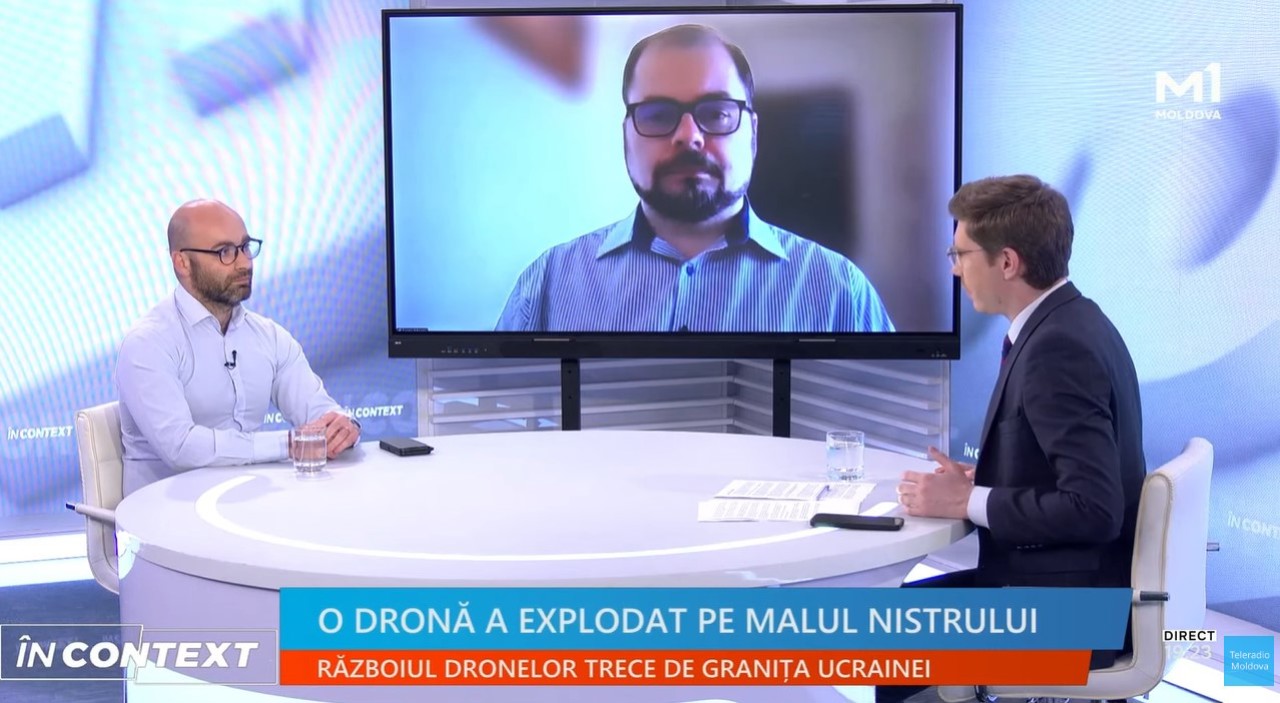
"We are in a situation where neither the Republic of Moldova nor Romania can defend themselves at this moment from drones entering their territory. And with all the difference in capacity that a more developed NATO member state, such as Romania, should have, we must actually realize that the exposure is similar. In both states, the same incidents can happen, they can be much more serious incidents than the ones that happened now, because these drones can fall on inhabited areas, in areas where there is fuel", Sergiu Mișcoiu declared in the show IN CONTEXT on Moldova 1.
The political scientist also emphasizes that the Republic of Moldova is exposed to additional risks due to its neutral status, but believes that approaching the European Union can bring additional security guarantees.
"It seems an even easier target at first glance because it is a country that is not a NATO member, that does not have state-of-the-art military equipment, but that is making the effort, and rightly so, to defend itself as best it can and to find formulas to enter under the collective umbrella of Western defense. For now, these are still awaited, but with the negotiations for Moldova's accession to the European Union and Moldova's rapprochement with the Euro-Atlantic space, there are chances that Moldova will be better defended in the future than it is at the moment", stated Sergiu Mișcoiu.
"There are still big gaps in terms of defense," notes the expert, who believes that the incident at the port of Constanta was one of the most dangerous security episodes in recent years, given the critical infrastructure nearby.
"The latest incident in Romania, the one with the maritime drone, which was either lost under control by the Ukrainians through Russian jamming, or was remotely guided by Russian hackers and Russian military counterintelligence to the port of Constanta, represents an extremely serious case, because there were ammonium nitrate deposits and oil deposits in the area. We could have had a major catastrophe that we could not prevent and we did not know how to deal with, even when the subject appeared on the radars of the Romanian Army", Mișcoiu also explained.
The political scientist states that there are indications that suggest the "deliberate nature" of the attacks, and that the drone that hit the apartment building in Galați would have followed a trajectory that was not "accidental".
"Military experts claim through various ballistic evidence that we are dealing with an intentional trajectory of the drone that also made evasive maneuvers over the water surface so that the radars would not capture it and that the objective was indeed a block of flats in Galați as the best target option that the Russian drone operators found. This really means, if we are in this second case, that things are serious, that we will actually have a higher incidence of these events in the near future and that they will be repeated and perhaps even intensified", detailed Sergiu Mișcoiu.
With reference to the measures adopted by Romania to strengthen air defense, the expert welcomes the acceleration of the European SAVE mechanism.
"Romania signed the contracts for SAVE earlier and there is a very ambitious, expensive and hopefully effective project in the case of drone defense. When it is effective, it will probably be able to defend Romania along its eastern border, but this project will take a year and a half to implement. It is estimated that it will take a year and a half. The problem is that we do not have this time, we are not in the phase where the war is frozen, but in full swing and the incidents, as we see, are multiplying", Mișcoiu also declared.
Regarding the peace negotiations, the political scientist believes that the Kremlin leader continues to believe that Russia has the strategic advantage, despite the massive losses since the start of the war in Ukraine.
"The multiplication of incidents on Russian territory with attacks in Moscow, St. Petersburg and numerous other cities shows that Russia is very vulnerable. The drone war is currently being won by Ukraine and if Ukraine had been supported from the very beginning of this massive war by Western partners, including with combat equipment, then Ukraine would be in a different position today than it is now. Both in a territorial sense and especially in the sense of air supremacy through drones. Ukraine's ability to export technological "know-how" and to export drone maneuvering capacity in the conditions in which it has been besieged for four years by a hostile state tens of times larger", concluded Sergiu Mișcoiu.
On the set of the show IN CONTEXT, military historian Artur Leșcu warned that the Russian Federation is resorting to an increasing number of aerial provocations as it encounters difficulties on the front, but it remains solely responsible for the security risks affecting the states in the region today.
"This is how the Russian Federation behaves. And the effects are great. NATO is on fire. Romania is on fire. Ukraine is on fire, Moldova is on fire just because a few Russian drones hit civilian blocks. (...) The weaker the Russian Federation is on the battlefield, the more it will use such tricks that are, as I said, much easier to carry out and much cheaper", declared Artur Leșcu.
In this context, the expert stressed the importance of cooperation with the member states of the European Union for initiatives in the defense industry and investments in the military sector.
"I am waiting for our society to finally understand that investing in the army is first and foremost an investment in your safety and well-being. And probably, why not, we have all the components to become important in this field. Let's produce drones locally here. (...) The production and even the equipping of the army is the prerogative of the state alone. Now times are changing. Some partnerships are probably also needed", explained Leșcu.
Although the Republic of Moldova has modern radars and benefits from information exchange with external partners, the expert warns that the defense system does not cover the entire territory of the country.
"Now they also want to invest in electronic warfare means. What does that mean? So that we have some utensils, tools with which we can divert the flight path of these ultimately enemy devices", concluded Artur Leșcu.
Following the large-scale invasion of Ukraine, Moldovan airspace has been illegally overflown by Russian drones multiple times. The most recent incident occurred last night when an unidentified aircraft, believed to be a drone, crashed and exploded on the territory of the Republic of Moldova. Surveillance systems from the National Army and cross-border cooperation detected an unmanned aircraft crossing the Moldovan state border from the direction of the Mihailovca-Lopatna locality in Orhei at 00:20. Fragments of the drone are currently being examined to determine its origin and the circumstances of the incident.
The Ministry of Foreign Affairs (MFA) has consistently condemned these actions and highlighted the risks and consequences that Russia's war of aggression against Ukraine poses for regional security and neighboring countries. According to a press release from the MFA, "The unauthorized overflight of any flying object in the airspace of the Republic of Moldova, or its fall on national territory, constitutes a threat to national security and represents a violation of the country's sovereignty and territorial integrity."
The MFA emphasizes that regardless of the drone's origin—initial information suggests it may be of Ukrainian origin—the responsibility for any aircraft that enters Moldova's territory ultimately falls on Russia, which initiated the illegal conflict in the neighboring country.
In response, President Maia Sandu announced that the Republic of Moldova may begin producing its own drones and jamming systems, contingent upon legislative amendments. Currently, Moldova lacks the necessary technologies and expertise for intercepting unmanned aerial vehicles. To address this gap, the authorities plan to attract external partners through public-private partnerships. However, to facilitate this, changes to the legal framework are required. President Sandu also indicated that the state could seek Ukraine's expertise in developing its defense industry.