Moldova battles Russian deepfake election interference
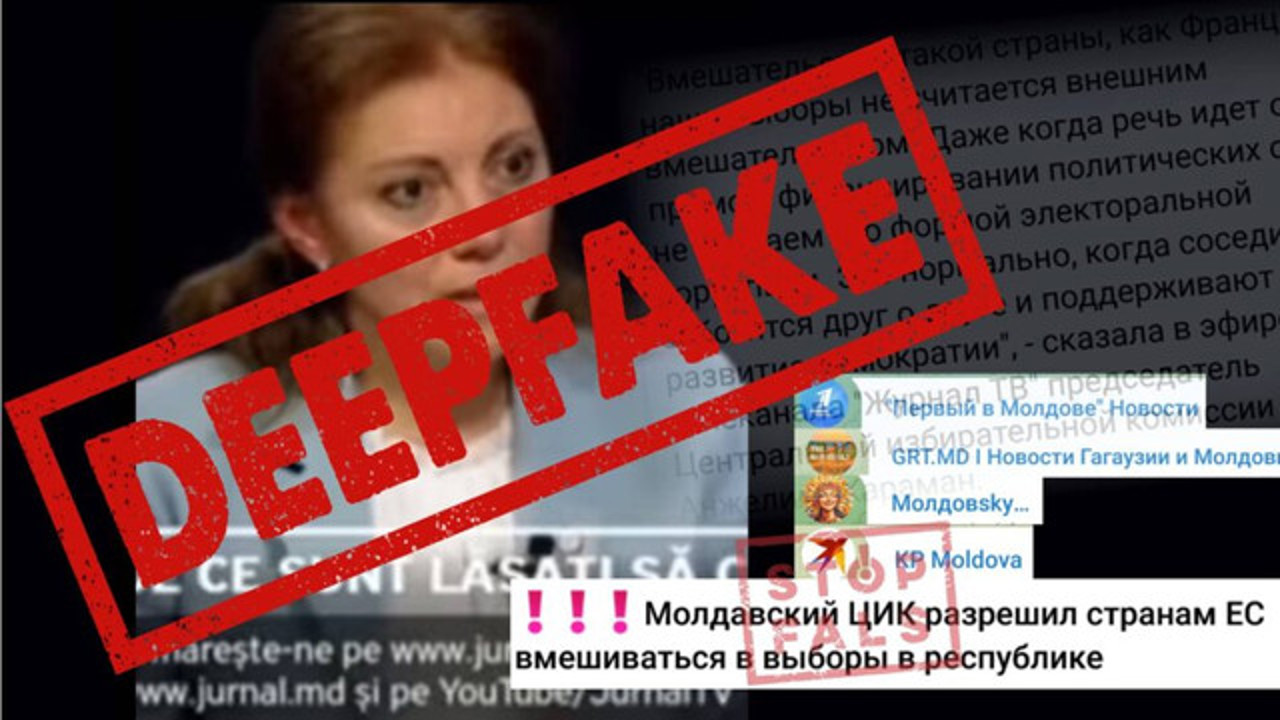
The Central Electoral Commission (CEC) condemned the distribution of a falsified video, generated with artificial intelligence (AI), in which the institution's president, Angelica Caraman, allegedly makes controversial statements about foreign interference in Moldova's elections.
The video was promoted by, among others, Maria Zakharova, spokesperson for the Russian Ministry of Foreign Affairs, and picked up by several pro-Russian Telegram channels and Russian websites.
The institution told Teleradio-Moldova that the images are fake and that Angelica Caraman "never made such statements."
"We are seeing an increasing number of cases using deepfake technologies in an attempt to destabilize the electoral process and compromise trust in democratic institutions," CEC representatives told Teleradio-Moldova.
The false narrative disseminated by Zakharova claimed that the CEC president had stated that "the intervention of a country like France in our elections is not considered foreign interference," because the Republic of Moldova was supposedly close to joining the European Union.
Maia Sandu: "It'll be a complicated period, but not impossible to get through"
In this context, President Maia Sandu urged citizens to exercise "prudence and discernment," warning that such false information will become even more frequent leading up to the elections.
"I saw an AI-generated video where an official said some things, and that video was fake. I saw many well-informed people, including those whose work involves combating fakes, who fell into this trap. What we're trying to say is that such videos and messages will appear daily, in very large numbers, and it'll be very hard to understand where the truth is and where lies are. It'll be a complicated period, but it's not impossible to get through well if we're all vigilant, if we're united, if we know how to love our country and not let ourselves be drawn into these corruption schemes," the head of state stated last night in an interview with Jurnal TV.
A rumor was also launched on Telegram claiming that Telegram and TikTok might be suspended in the Republic of Moldova two weeks before the September 28 elections. This information, presented as the government's intention, was widely shared on social media.
The government, through spokesperson Daniel Vodă, denied the claim, stating it was "speculative" and launched with the aim "to stir emotions before the elections."
"We'll continue dialogue and collaborate with platforms to eliminate content dangerous to national security, such as foreign disinformation campaigns, as well as content threatening people's safety—including drug trafficking and content harmful to children," Vodă explained.
President Maia Sandu also stated on July 30, regarding the same topic, that authorities don't wish to resort to "extreme measures," such as suspending Telegram.
"We don't want to resort to these measures and are trying other solutions," the president noted.
Moldova is a target for disinformation
It's worth recalling that after the Supreme Security Council (SSC) meeting on July 30, Maia Sandu warned that Russia plans to influence the results of the autumn parliamentary elections through destabilization actions, disinformation campaigns, hidden financing, and paid protests.
The Republic of Moldova has recently been the target of increasingly intense disinformation and foreign influence campaigns, conducted in the context of the upcoming autumn parliamentary elections. According to Chisinau authorities, these actions are orchestrated by the Russian Federation and its affiliated networks, aiming to undermine the country's European path, discredit pro-European leaders, and create confusion in society.
Strategies used include promoting fake news, attacking state institutions, using social networks and media platforms that mimic credible sources. Furthermore, there's been an amplification of messages targeting sensitive topics such as security, religion, national identity, and democratic values.
Translation by Iurie Tataru